
Toward Unconventional Oil Reservoirs: A New Frontier in Exploration
Interview with Dr. Hamzeh Mehrabi, Faculty Member at the school of Geology, College of Science, University of Tehran
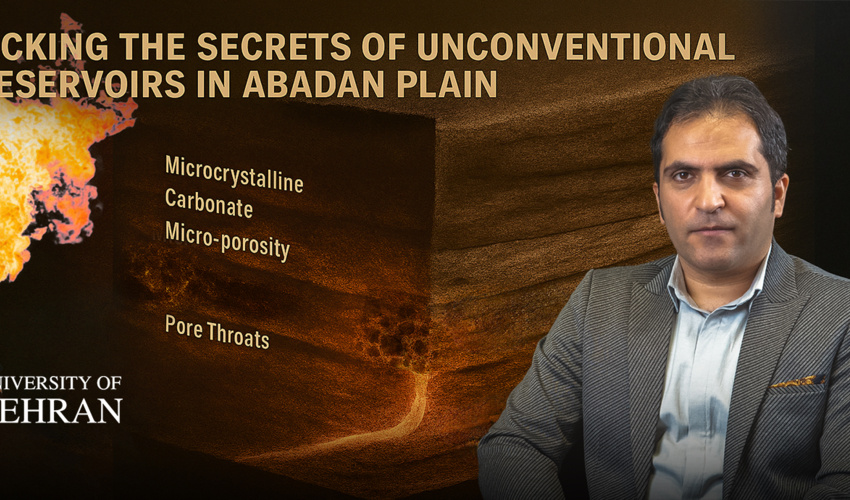
Ehsan Shirkhanlo reporting from the Vice-Presidency for Research and Technology News Desk of the University of Tehran:
For the first time in Iran, a research team from the University of Tehran, led by Dr. Hamzeh Mehrabi and with the distinguished contribution of Engineer Elham Talebi, Ph.D. candidate at the Department of Geology, has identified a new type of unconventional oil reservoir in the Abadan Plain. This discovery may redefine the future of oil exploration and extraction strategies in Iran’s energy sector.
Dr. Mehrabi explained:
“Oil and gas reservoirs around the world are categorized into two types: conventional and unconventional. Conventional reservoirs possess high porosity and permeability, allowing oil to reach the surface naturally under subsurface pressure. In contrast, unconventional reservoirs lack sufficient permeability, and oil cannot flow naturally—advanced extraction technologies are required.”
According to Dr. Mehrabi, the study initially aimed to investigate conventional reservoirs in the region, but detailed petrophysical, geological, and capillary pressure analyses revealed the existence of a reservoir with unconventional characteristics.
“Our results showed that the carbonate rocks of the Abadan Plain have a porosity of up to 25%, which is quite significant. However, their permeability is less than one-tenth of a millidarcy—extremely low. This means the oil is trapped within the rock and unable to migrate.”
He added:
“Approximately two-thirds of the reservoir exhibits unconventional properties. This means that the oil currently being produced from the region originates only from the upper one-third of the formation. These findings could dramatically change future extraction strategies.”
Why This Discovery Matters?
Dr. Mehrabi emphasized that Iran has entered the second half of its conventional reservoir lifespan, making the identification of unconventional reservoirs a national necessity rather than a luxury.
“In many countries, the volume of oil contained in unconventional reservoirs surpasses that of conventional ones. We must begin preparing for the next stage of our energy future today.”
According to him, the study’s multidisciplinary data — encompassing geological, geophysical, petrophysical, and geochemical analyses — will provide essential input for petroleum engineers to design optimized extraction techniques.
“These data serve as the foundation for engineers to determine the most efficient recovery methods for unconventional reservoirs. Within our Department of Geology at the University of Tehran, several teams have been engaged in this line of research for years, and we are determined to continue with greater intensity.”
A Warning for the Future: The Need for a Paradigm Shift
Dr. Mehrabi concluded with a strong message of caution:
“I warn policymakers and renewable energy advocates that our oil and gas resources will inevitably deplete in the not-too-distant future. We must accelerate the development of renewable energies with far greater urgency and determination. If we fail to act now, the cost will be borne by all of us. This is the time for a revolutionary and collective movement in the field of energy.”
Your Comment :