
Reducing Poultry Industry Costs with a Recombinant Vaccine Developed by a University of Tehran Researcher
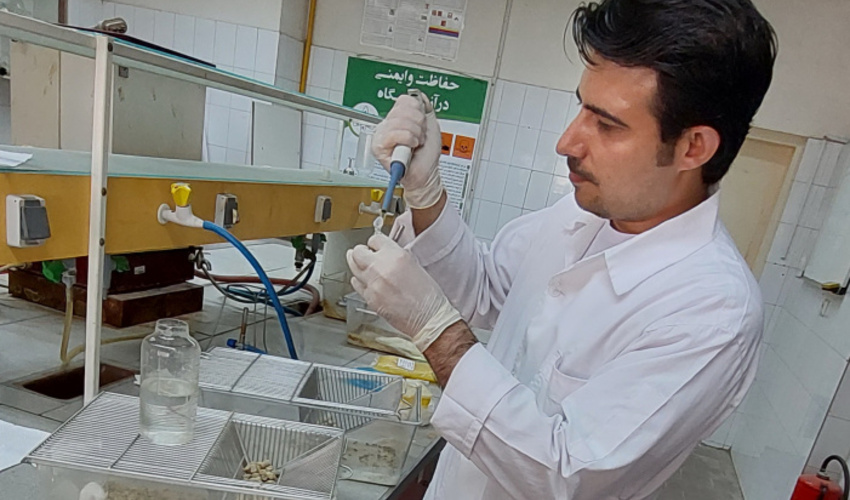
The thesis of Amir Asghari Baghkhairati, a Ph.D. student at the Faculty of Veterinary Medicine, University of Tehran, titled "Yeast surface display of a part of the H9 antigen (HA-RBD) as a specific vaccine candidate against avian influenza subtype H9N2 in Iran," was selected as one of the country's chosen demand-driven research projects in 1403 (2024/2025).
This research aimed to develop a novel method for producing avian influenza vaccines and could significantly impact reducing economic losses in the poultry industry and enhancing public health. Below, we examine the details of this research and its achievements through questions to Dr. Asghari:
What steps did you take to choose your thesis topic? Was the initial idea from you, your supervisor, or a collaborative effort?
"My main goal from the beginning was to address one of the fundamental challenges of the poultry industry, namely influenza. The initial idea was proposed by my supervisor, and under his guidance and that of other professors, I brought this practical project to fruition to reduce the economic damages of this disease."
How does this research connect to your past work or that of other researchers?
"My professors have a rich background in poultry disease research and genetic engineering. I have also researched the most important poultry diseases such as influenza and hepatitis E, malaria, Klebsiella, as well as novel antimicrobial peptides and genetic engineering during my studies. Given Iran's position in poultry production, developing this vaccine can prevent economic losses. Since Iran is one of the top 14 countries in chicken meat and egg production globally, creating an effective and efficient vaccine, by providing immunity and preventing disease, can avert economic losses of several thousand billion tomans caused by influenza."
What was the main problem this research addressed? Had it been overlooked in the industry or previous research?
"Unfortunately, some students only think about completing their studies and pay less attention to practical projects to solve the problems of the poultry industry. Furthermore, implementing such projects requires continuous effort, financial support, and adequate facilities. Despite the importance of avian influenza in the poultry industry, effective communication between the university and the industry has not been established, and many previous studies have been merely theoretical without practical application."
"Avian influenza (H9N2) has caused significant economic losses in Iran, and the traditional inactivated vaccines used have serious limitations, including:
* Risks of working with live virus
* Need for millions of fertilized chicken eggs
* Costly and time-consuming production process
* Ineffectiveness in case of a human pandemic
* Need for injection (which increases vaccination costs).
These limitations show that traditional vaccine production methods cannot meet future needs, and there is a demand for innovative solutions."
"The main objective of this thesis was to design and produce the first recombinant avian influenza (H9N2) vaccine in Iran, which, by eliminating the need for live virus and fertilized eggs, would reduce production costs and increase efficiency. This vaccine, with the capability of being used through non-injectable methods such as oral, drinking water, spray, and eye drop administration, was successfully developed after years of genetic studies, specific design, and extensive bioinformatic, laboratory, and animal tests."
What key tools or methods were used? And why did you choose these options?
"To produce this vaccine, *Pichia pastoris* yeast was used, which is a very safe yeast, has probiotic properties, has a very high capacity for producing recombinant proteins, and is free from endotoxin contamination. Its injection into animal models has shown no side effects. This vaccine is produced without using live virus, without the need for fertilized eggs, with lower cost and higher efficiency, and has the potential for use via injection, drinking water, spray, and eye drops."
"Among the methods used are bacterial transformation by heat shock, yeast transformation by electroporation, purification of the recombinant protein using a column containing charged nickel particles, bacterial and yeast cultures in specific media, and various tests including Polymerase Chain Reaction (PCR), plasmid extraction, SDS-PAGE, *in vitro* tests, animal tests, *in vivo* tests, *in silico* (computer) tests, bioinformatics analyses, and computer simulation of the recombinant protein using a supercomputer."
What was the biggest unexpected challenge? How did you analyze and solve it?
"One of the most important challenges in producing this recombinant vaccine was the lack of financial support and adequate facilities. This caused some stages of vaccine production to progress slowly."
If you had unlimited resources, what direction would you take to develop this research?
"Given the scientific capability of this research team, I can boldly say that if we had sufficient resources and facilities, we would have the ability to develop advanced vaccines of the world and could take steps towards preventing various diseases in livestock and poultry and preventing economic damages amounting to several thousand billion tomans in the country."
If you could tell students just one thing for writing an outstanding thesis, what would it be?
"With trust in God and a strong will, choose your thesis in line with solving industry problems and helping production, and see it through to the end. Although it is very difficult, the ending is good."
In conclusion, I sincerely thank the supervisors of this dissertation, Dr. Jamshid Razmar (Associate Professor, Faculty of Veterinary Medicine, University of Tehran), Dr. Mohammad Hadi Sakhaei (Associate Professor, Faculty of Agriculture, Ferdowsi University of Mashhad), and also the advisory professors, Dr. Seyed Mostafa Peighambari (Full Professor, Faculty of Veterinary Medicine, University of Tehran) and Dr. Kiarsh Kazemi (Professor, Mashhad University of Medical Sciences), who have always guided me on the path of learning and the advancement of my dear country, Iran.
Your Comment :