Shedding Light on a Connection in the History of Science!
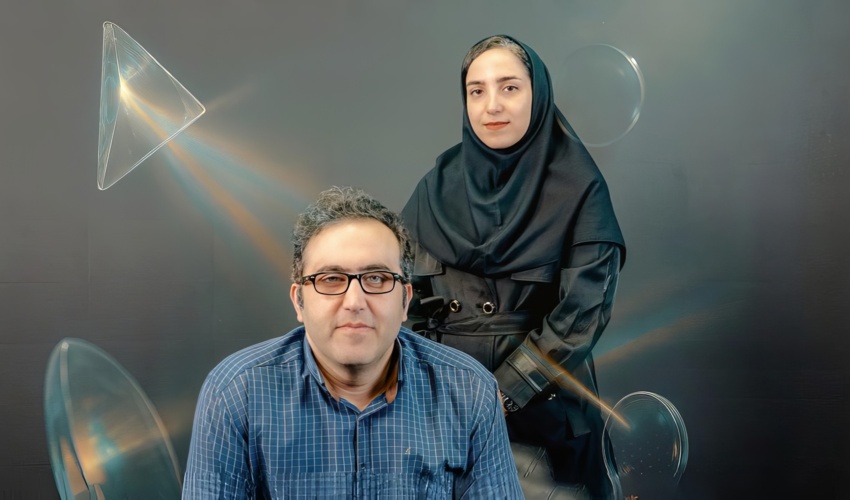
A Conversation with Arezo Egherlou and Her Supervisor, Dr. Hanif Ghalandari, Institute for the History of Science, University of Tehran
Ehsan Shirkhanlo reporting from the Vice-Presidency for Research and Technology News Desk of the University of Tehran:
A recently completed study at the Institute for the History of Science at the University of Tehran has illuminated a previously unknown part of Islamic astronomical history. This research shows that Muslim scholars, centuries ago, understood and documented the relationship between astronomy and optics with much greater precision than previously thought.
Arezou Egherlou, a graduate of Pure Physics and a researcher in the field of the History of Science, completed her Master's thesis under the supervision of Dr. Hanif Ghalandari, Professor at the Institute for the History of Science. Her work focused on one of the lesser-known commentaries on "Al-Tadhkirah fi 'ilm al-hay'ah" (Treatise on the Science of Astronomy), a major astronomical text written by Nasir al-Din al-Tusi, which is considered one of the most important sources in the Islamic world.
Al-Tusi's "Al-Tadhkirah" is a prominent scientific work in which he only included the main points of the topics, and this brevity made it difficult for subsequent scholars to understand. For this reason, over four centuries following al-Tusi, approximately 14 commentaries were written by various scholars to explain and elaborate on the book's contents.
Egherlou’s thesis focused on a commentary written about 200 years after al-Tusi by a scholar named Fathallah al-Shirwani. The significant point of this commentary is that Shirwani added a new chapter in which he attempted to explain why celestial bodies appear larger on the horizon.

A Crucial Step: From Astronomy to Optics
The importance of this chapter lies in the fact that Shirwani links the analysis of astronomical phenomena to the understanding of optical phenomena—a relationship that had not been precisely presented in this manner before. To explain the issue, he starts with the structure of the eye and concludes the discussion with explanations regarding shadows—an uncommon approach in astronomical commentaries.
Prior to this research, many scholars believed that the works of Ibn al-Haytham—the Father of Modern Optics—were not extensively referenced or utilized by Muslim scholars. However, Egherlou discovered and proved Shirwani's precise and numerous references to Ibn al-Haytham and his work, "Fi Ru'yat al-Kawakib" (On the Visibility of the Stars), in this commentary. These references are likely the first explicit citations of this important work in the history of Islamic astronomy.
This finding suggests a new interpretation:
Muslim scholars not only knew of Ibn al-Haytham’s works but also actively applied them in astronomical discussions, analyzing observational errors based on optical principles—and not merely as equipment failure or simple viewing error.

From Pure Physics to the History of Science
Regarding the reason for choosing this topic, Egherlou stated:
"I studied Pure Physics during my undergraduate degree, and when I entered the History of Science field, I wanted to pursue topics rooted in Physics. Optical discussions in the history of science were fascinating to me, which led me to this commentary."

History of Science: Accurate Narrative, Not Salvage Work
At the end of the session, Dr. Hanif Ghalandari emphasized the mission of the Institute for the History of Science:
"The history of science is not salvage work; we seek to draw an accurate and clear picture of the past. This data helps people understand why a certain scholar in the past was great and what role they played in global science. If we do not create this narrative, others will distort it."
In a direct address to the officials of the University of Tehran, he concluded:
"The Institute for the History of Science needs to return to its prime days. The history of science is one of the pillars of the country's cultural identity and pride, and ignoring it means abandoning one of Iran's most important intellectual assets."
Watch the interview clip with English subtitles below.
Your Comment :