
An Interview with Minoo Ghanbarzad, Exemplary Research Expert
The Vice-Presidency for Research and Technology News Desk of the University of Tehran:
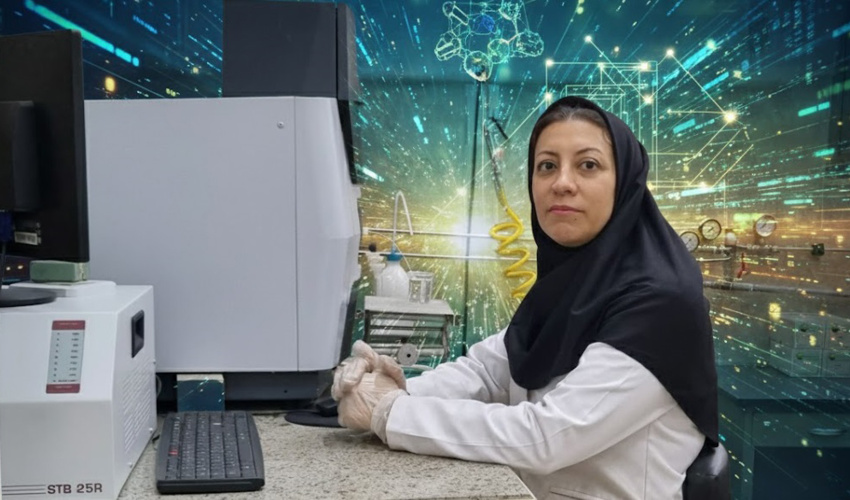
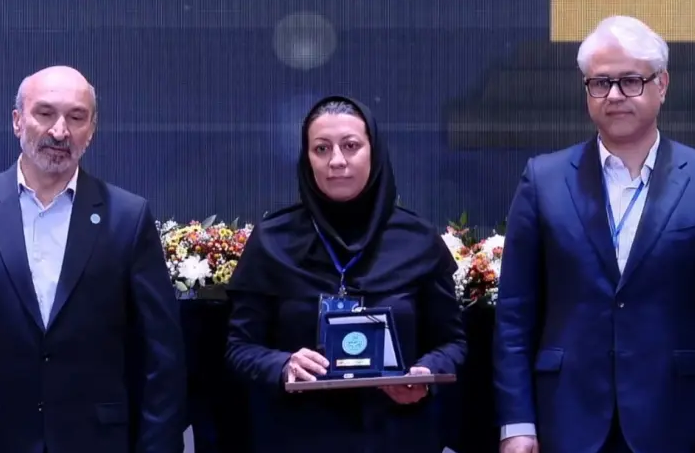
Ms. Minoo Ghanbarzad, the laboratory expert in charge of the Geochemistry Laboratory at the Faculty of Mining Engineering, was selected and honored as the "Exemplary Research Expert" at the 34th Research and Technology Festival of the University of Tehran, held on December 14, 2025 (23 Azar 1404), at the Allameh Amini Hall. On this occasion, we sat down for an interview with her to discuss her activities and perspectives in the field of research and laboratories. The full text of the interview is presented below.
Please introduce the laboratory where you work.
The Geochemistry Laboratory is responsible for the assaying of mineral materials related to student theses, as well as research and industrial projects, based on the laboratory's available facilities and capabilities. These assays are conducted using both instrumental and classical methods. The laboratory is equipped with two Atomic Absorption units and one Spectrophotometer. The head of the laboratory is Dr. Mohammad Noaparast, a Full Professor of Mining Engineering, specializing in Mineral Processing.
What is the difference between a routine experiment and one that leads to a significant research achievement?
In a routine experiment, data is only used to confirm or refute a hypothesis. However, in a significant experiment, the researcher is prepared to observe unexpected results and does not ignore them. Many great achievements have started from a result that was not initially intended to be important.
How do you evaluate the role of precision and equipment calibration in the international credibility of the university's research outputs?
These factors play a very effective and vital role in the credibility of research. In fact, equipment calibration is a direct investment in the scientific and research reputation of the university.
Has there been an instance where a technical suggestion or a change in the experimental protocol led to the success of a research project?
Yes, there have been cases where, by making small technical adjustments to the instruments and experimental methods, more accurate measurements were achieved. This action prevented the repetition of experiments and ultimately resulted in savings of both time and cost.
What was the greatest technical challenge you faced during your career in the laboratory, and how was it resolved?
For example, smart standardization in the field of quantitative elemental analysis was my biggest challenge, which I resolved through further research and analysis.
How have you managed to maintain laboratory standards under conditions of resource constraints or equipment sanctions?
Admittedly, having up-to-date and standard equipment is a crucial matter in research. However, I strive to focus on precision, utilizing accurate documentation, choosing the correct methodology, comparing results, and maintaining honesty in reporting to ensure the quality of work is preserved.
What challenges arise when interacting with graduate students, and how do you guide them?
The biggest challenge is that students often want to reach the final result very quickly. Through patient training and providing simple explanations, I emphasize accuracy and the documentation of every step, so that the student gradually finds the correct path.
In your opinion, what infrastructural priorities are needed for university laboratories to reach a world-class level?
To reach a global level, laboratories urgently need standard equipment, quality control systems, skilled human resources, scientific transparency, and collaboration with international peers.
What is the most rewarding moment for you in the workplace?
It is deeply gratifying when, after hours of sample preparation and intense focus, a satisfactory result is achieved. Also, whenever a piece of equipment is repaired or serviced, I feel a sense of security and peace of mind.
If you were to share a "trick of the trade" (secret of success) with new students, what would it be?
I advise them to exercise maximum precision in sample preparation; most errors stem from the preparation and homogenization stages.
What ethical trait or skill do you believe led to your selection as this year's Exemplary Research Expert?
I believe this selection is the result of constructive cooperation with the hardworking professors, colleagues, and students of the Faculty of Mining Engineering. I have always endeavored to perform both the experimental tests and the guidance of students correctly, with precision, patience, and transparency.
PARS MEDEQ company, sponsor of Vice-Presidency for Research and Technology News Desk
Your Comment :