Prolific Research by University of Tehran Professor in Petroleum Geology
Kosar Shakori from the Vice-Presidency for Research and Technology News Desk of the University of Tehran:
Prolific Research by University of Tehran Professor in Petroleum Geology
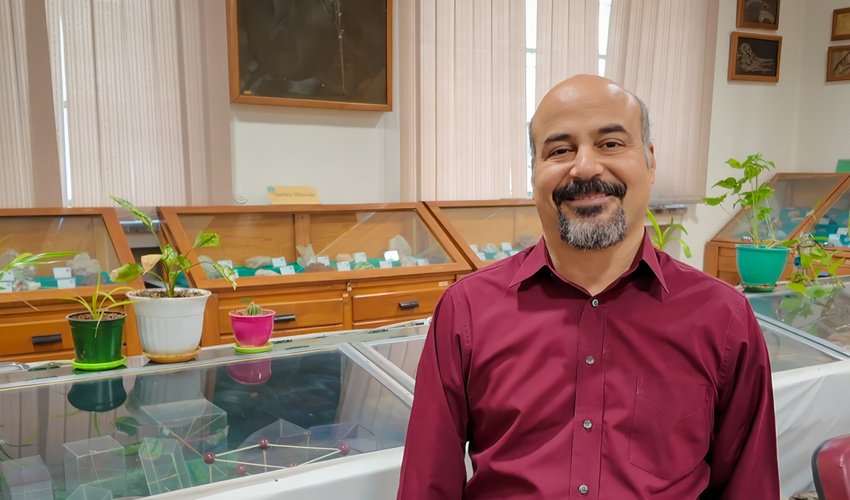
Dr. Vahid Tavakoli, a faculty member at the University of Tehran’s College of Geology, plays a pivotal role in advancing hydrocarbon reservoir studies and discovering new plays in the Persian Gulf. His expertise in Petroleum Geology—focusing on subsurface reservoir evaluation—has culminated in the publication of approximately 180 scientific articles and three international textbooks.
Dr. Tavakoli describes his field as integral to comprehensive reservoir studies, primarily tasked with quantifying subsurface hydrocarbons. He notes that the oil field discoveries and reserve estimates frequently reported in the media are the direct result of petroleum geologists' rigorous analysis of reservoir formations.
Academic Background and Career Progression
Dr. Tavakoli began his academic journey in 1998, enrolling in Geology at the University of Tehran. After earning his B.Sc. in 2002, he immediately pursued an M.Sc. in Sedimentology and Sedimentary Petrology. He subsequently completed his Ph.D. in Petroleum Geology at the same institution, obtaining all three degrees from the University of Tehran. One year post-graduation, he was recruited by the College of Geology to faculty to teach Petroleum Geology.
Doctoral Research and Specialization
His doctoral research focused on the Permian-Triassic reservoirs of the Persian Gulf. Dr. Tavakoli explains that this interval dates back approximately 250 million years, harboring the vast gas reserves of the South Pars Field. His specialized activities remain centered on South Pars and other gas fields across the eastern and western sectors of the Persian Gulf.
Reservoir Studies and Inter-well Modeling
The professor has conducted diverse studies on Persian Gulf reservoirs, ranging from diagenetic alterations to subsurface modeling. His core expertise lies in inter-well modeling, which determines lateral variations between boreholes. He highlights:
the complexity of this task, noting that reservoirs are situated 1 to 3 kilometers underground; while a typical wellbore is only about 20 cm in diameter, the reservoirs themselves span several kilometers in width and hundreds of meters in thickness.
Discovery of New Plays and Current Developments
Research conducted by Dr. Tavakoli and his student team has investigated hydrocarbon systems, specifically focusing on structural and lithological traps in the Persian Gulf. While anticlinal traps are the most common, the team has shifted focus toward smaller, subtle traps formed by lithological variations. As major fields reach their mid-life stages, these smaller accumulations have gained strategic importance. Their project successfully identified three small oil fields and calculated their reserves, which have since been added to Iran’s total discovered inventory.
These reservoirs are undetectable via seismic data alone and require advanced modeling using specialized software and geological time reconstruction techniques. National oil companies are currently evaluating the economic viability of these assets for future extraction.
International Collaborations and Publications
Dr. Tavakoli emphasizes extensive international collaboration with experts from Australia, Uzbekistan, China, the USA, and Sweden. This collective effort has resulted in 180 papers in prestigious international and domestic journals. Furthermore, he has authored three English-language textbooks (two published in Switzerland and one in the USA) alongside three Persian volumes.
Paleobotanical Studies
His research scope has recently expanded into paleobotany to reconstruct the region’s ancient vegetation. Current projects involve analyzing fossilized plants, pollen, and spores, integrating these findings with sedimentological data. This interdisciplinary approach aims to provide a holistic view of geological history, including ancient human settlement patterns and migration drivers.
PARS MEDEQ company, sponsor of Vice-Presidency for Research and Technology News Desk
Watch the interview clip with English subtitles below
Your Comment :