
Head of Business Research Laboratory at University of Tehran: Iranian Managers Need “Mental Exercise”
Dynamic Decision-Making in Complex Environments: Managers’ Brains Under the Scalpel of Intuition and Sanctions
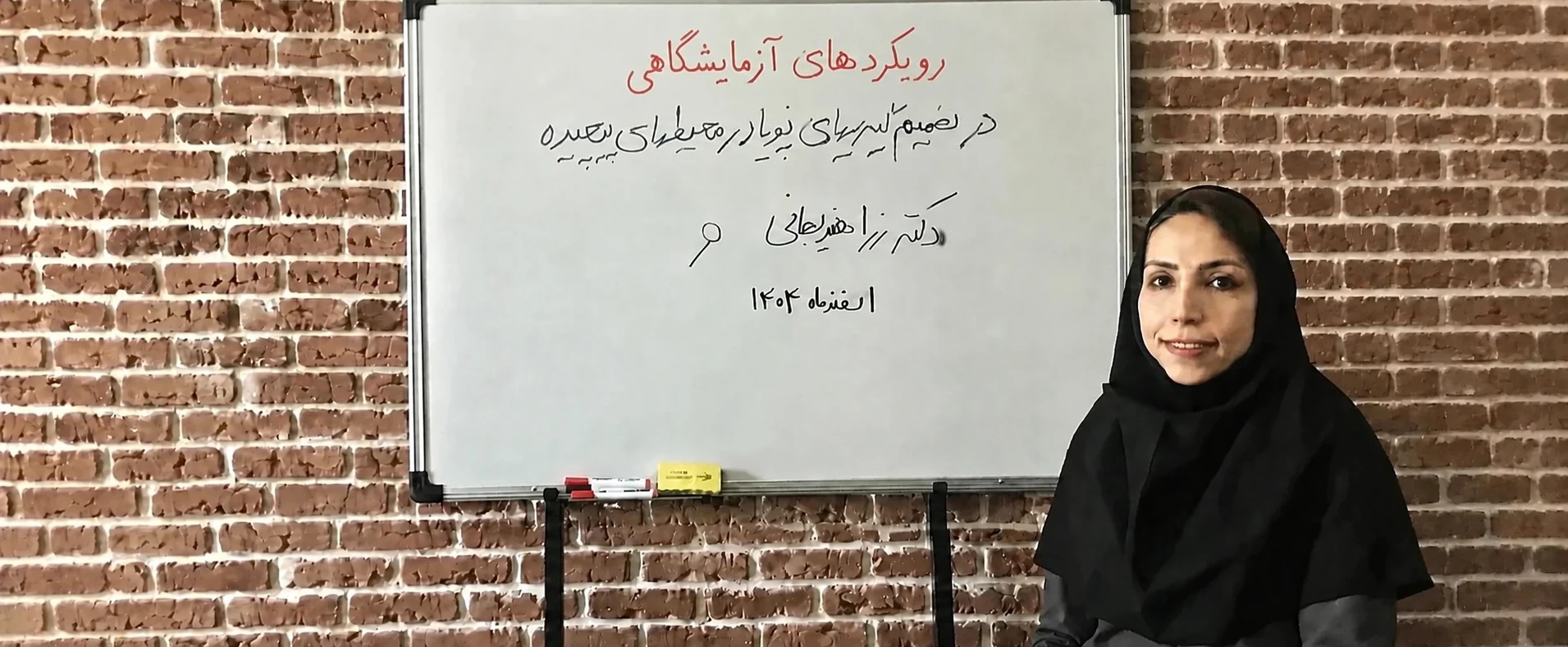
Milad Moein from the Vice-Presidency for Research and Technology News Desk of the University of Tehran:
While economic warfare and soft and hard sanctions have transformed Iran’s business environment into a “living laboratory” of complex crises, findings from a research study reveal why Iranian managers make systematic errors in long-term decision-making. Dr. Roza Hendijani, faculty member of the Strategy Group and Head of the Business Research Laboratory at University of Tehran, states in this exclusive interview that “holistic thinking” and “mental exercises” can be the key to overcoming managerial deadlocks.
The Fatal Difference Between Static and Dynamic Decision-Making
Dr. Hendijani, who holds a PhD in Management from the University of Calgary, Canada, and has teaching experience at the University of Colorado Boulder, USA, distinguishes between two types of decision-making:
“Static decision-making means examining behavior in a single, fixed situation; but dynamic decision-making means making decisions over time, where the individual faces changing conditions and various feedback loops.”
According to her, Iranian managers often become trapped in systems with a “gap between decision and outcome”—where the effect of a decision is not immediately visible and the manager feels the “lever” isn’t working, when in fact the timing mechanism is simply slower. Studies from his laboratory show that when people don’t get immediate results and cannot track changes moment by moment, they make more hasty decisions that create disasters.
Sanctions, Equipment Challenges, and the Human Brain
While the Business Research Laboratory at University of Tehran is the first and most advanced center in management and economics in Iran—equipped with eye-tracking units, brain signal recording, behavioral finance laboratory, and artificial intelligence facilities—Dr. Hendijani speaks of the challenges posed by sanctions: “We even face shortages of up-to-date computers. University systems still run on old operating system versions that are not suitable for advanced equipment like eye trackers.” These limitations persist even as the center attempts to strengthen “rationality” and “holistic thinking” factors in managers through behavioral simulations.
Mental Exercise: The Forgotten Solution
The key finding of this exclusive research points to “mental exercise.” Dr. Hendijani recommends that managers exercise their brains just as they exercise their bodies: “Solving simple mathematical calculations, difficult logical reasoning questions, and practicing looking at the totality of images rather than getting lost in details.” According to her, the most prevalent behavioral bias in Iran is “reduced rationality and lack of holistic perspective”—managers focus on a momentary event rather than seeing the entirety of the supply chain or macro strategy, and make immediate but dangerous decisions.
Mental Causality: Broken Determinism in the Manager’s Hand
Dr. Hendijani’s exclusive theory of “motivational congruence” introduces the concept of “total motivation,” which is a combination of intrinsic, extrinsic, and environmental motivations. He believes “mental causality” is real:
“Our mind and internal motivations truly affect external events. A manager’s positive thoughts can impact the entire organization and even society.”
This perspective becomes more important than ever in current conditions where a “security mindset” has prevailed—where managers must understand that their mind is not merely an analyzer but an “agent of change.”
Simulation Games: The Future of Iranian Management
The Business Research Laboratory, in collaboration with researchers from Germany and Canada, has designed simulation games for conflict management and teamwork so managers can assess the unintended consequences of their strategies before implementing them in the real market. This is because in the real environment, failure carries massive costs and managers attribute it to external factors, but in the laboratory, macro factors like politics and sanctions are set aside so individuals can see their actual role.
Now that three months have passed since that interview and sanctions have intensified, this question arises: Will Iranian managers seize the opportunity for “mental exercise” before entering deeper crises?
PARS MEDEQ company and the Mossalanejad Cultural Foundation are the sponsors of Vice-Presidency for Research and Technology News Desk
Your Comment :