
Academic Insight & Interview Analysis
The Strategic Pivot from Intuitive to Data-Driven Marketing: Loyalty Engineering and Emerging Product Development in Platform Ecosystems
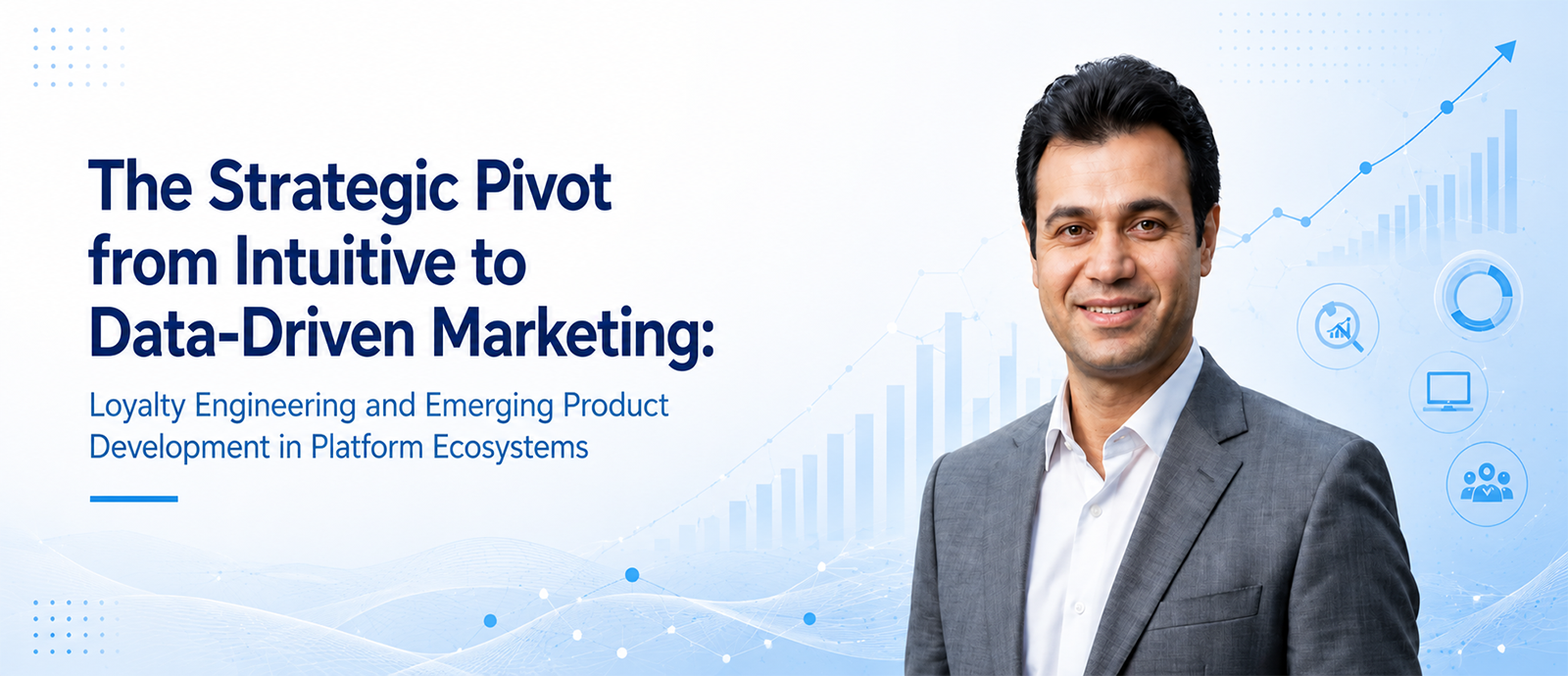
:Milad Moein from the Vice-Presidency for Research and Technology News Desk of the University of Tehran
University of Tehran – Faculty of Management: In contemporary management discourse and the entrepreneurial ecosystem, terms such as "data-driven marketing" and "artificial intelligence (AI) integration" have achieved significant prominence. However, the precise empirical maturity of organizations operating within transitional economies regarding these paradigms remains a critical question. To evaluate these dynamics, the Research Division conducted an in-depth interview with Dr. Nader Seyed Amiri, Associate Professor at the Faculty of Management, University of Tehran. Renowned for his academic supervision of advanced doctoral dissertations in digital entrepreneurship and platform marketing methodologies, Dr. Seyed Amiri provides a rigorous critique of the structural challenges, strategic opportunities, and future trajectories of data analytics within the domestic business landscape.
Fragmented Maturity: The Current Landscape of the Corporate Ecosystem
Assessing the macroeconomic transition from traditional, heuristic-driven marketing to advanced data-centric paradigms, Dr. Seyed Amiri characterizes the current state as one of "unbalanced or fragmented maturity." He argues that this strategic pivot is no longer a voluntary discretionary choice, but rather a vital survival mechanism. The high failure rates observed among early-stage startups, compounded by the volatile behavioral dynamics of platform consumers, leave no room for reliance on unscientific assumptions or conventional intuition.
He notes that enterprise-level digital platforms—specifically those dominating e-commerce, fintech, and on-demand mobility sectors—have successfully advanced to predictive and prescriptive data optimization tiers. Conversely, the vast majority of the corporate ecosystem, particularly small and medium-sized enterprises (SMEs), remains constrained within the descriptive analytics phase. These entities merely document and report historical events, exhibiting a profound decoupling between continuous data pipelines and high-level strategic decision-making architectures.
Data-Averse Culture: The Structural Achilles' Heel of Organizations
Dr. Seyed Amiri emphasizes that the primary barrier impeding the institutionalization of data-driven marketing extends far beyond hardware infrastructure or technological constraints. Instead, the root impediment resides within organizational culture and human capital deficits. Technical infrastructure can inevitably be acquired and developed despite market limitations; the fundamental bottleneck is an ingrained, data-averse organizational culture and a severe shortage of interdisciplinary analytical personnel.
The academic highlights a prevalent executive bias where data is treated ornamentally: executives selectively accept datasets that validate their pre-existing personal intuitions while systematically dismissing contradictory analytical insights. This systemic vulnerability is further exacerbated by the severe organizational disconnect between data scientists (Data Scientists) and strategic marketing teams.
Today, organizations urgently require "bridge engineers" capable of translating complex data-scientific syntax into actionable entrepreneurial marketing strategies. Without this cross-functional synthesis, capital-intensive technology infrastructures risk degenerating into obsolete data silos.
The Voice of the Customer: Text Data-Driven New Product Development (NPD)
A significant portion of Dr. Seyed Amiri’s current research portfolio focuses on Text Data-Driven New Product Development (Text data-driven NPD). Addressing the operational challenges of extracting actionable value from massive, unstructured user-generated content on digital networks, he proposes a rigorous, three-stage systematic framework: textual data preprocessing and cleaning via natural language processing (NLP/Text mining), thematic extraction of distinct product attributes, and multi-layered Sentiment Analysis.
"Textual data represents the unmediated, authentic voice of the consumer. When machine learning algorithms successfully formalize the frequency and variance of consumer sentiment toward explicit product variables—such as pricing architectures or packaging mechanics—the firm uncovers a verifiable 'product gap' or innovation window. Consequently, new product architecture is engineered directly around acute market friction points and consumer demand, totally replacing executive guesswork."
Loyalty Engineering: Predictive Analytics in Churn Management
Critiquing passive, reactive corporate retention strategies, Dr. Seyed Amiri—author of seminal works on stacking-based data mining solutions for customer churn prediction—argues that relying on lagging indicators is fatal in platform environments. Once a user abandons a platform or uninstalls an application, the churn event is fully realized, and the customer acquisition cost is forfeited.
Empirical evidence derived from advanced stacking-based ensemble data mining models indicates that consumers exhibit highly identifiable digital anomalies prior to defection, including decelerations in log-in frequencies and extended inter-purchase intervals.
By continuously monitoring these behavioral patterns, predictive algorithms categorize high-risk user segments. This shifts organizational posturing from a reactive state to a proactive state. Consequently, the automated system deploys hyper-personalized incentives or gamified interventions to engineer brand loyalty and revive user engagement prior to actual churn execution.
Neuromarketing and Artificial Intelligence: Decoding the Unconscious via Eye-Tracking
Drawing on successful empirical research conducted under his laboratory supervision using advanced Eye-Tracking technologies, Dr. Seyed Amiri demonstrates the utility of biometric instrumentation in uncovering latent consumer motivations. Traditional survey methodologies capture only the conscious, highly filtered cognitive layers where respondents consistently attempt to exhibit rational behavior. Conversely, eye-tracking methodologies penetrate the unconscious cognitive strata
Through experimental tracking on large-scale digital platforms, Dr. Seyed Amiri's research team generates precise visual heatmaps (Heatmaps), quantifying the exact millisecond-level attentional capture of sensory stimuli, promotional banners, and visual models. By integrating machine learning architectures with biometric outputs, qualitative and affective linguistic constructs (such as 'brand love') are converted into structured numerical vectors. This offers executive leadership empirical, quantified metrics for strategic decision-making.
Open Data and Gamification: Catalysts for Future Competitive Equity
Looking forward, Dr. Seyed Amiri views data democratization as a structural equalizer for nascent startups. The monopolization of big data by monolithic technology giants historically presented a formidable barrier to entry. However, open-data paradigms (Open Data) and the strategic liberation of public data repositories introduce a form of competitive equity. This allows underfunded startups to diagnose market trends and calibrate their unique value propositions without requiring prohibitive capital expenditures.
Concluding his assessment with a five-year strategic outlook for data-driven marketing, he identifies three foundational pillars: hyper-personalization, gamified engagement architectures, and localized generative AI.
The deployment of advanced gamification frameworks within digital platforms will inevitably yield richer behavioral datasets. Over the next five years, the marketing discipline will transition entirely from retrospective analytical reporting toward real-time dynamic optimization of the customer experience orchestrated by AI. The ultimate market leaders will be those organizations that proactively cultivate the required socio-cultural and scientific infrastructures today.
PARS MEDEQ company and the Mossalanejad Cultural Foundation are the sponsors of Vice-Presidency for Research and Technology News Desk
Your Comment :