
Prioritizing a Society-Centered Reading of Industrial Development

The Vice-Presidency for Research and Technology News Desk of the University of Tehran:
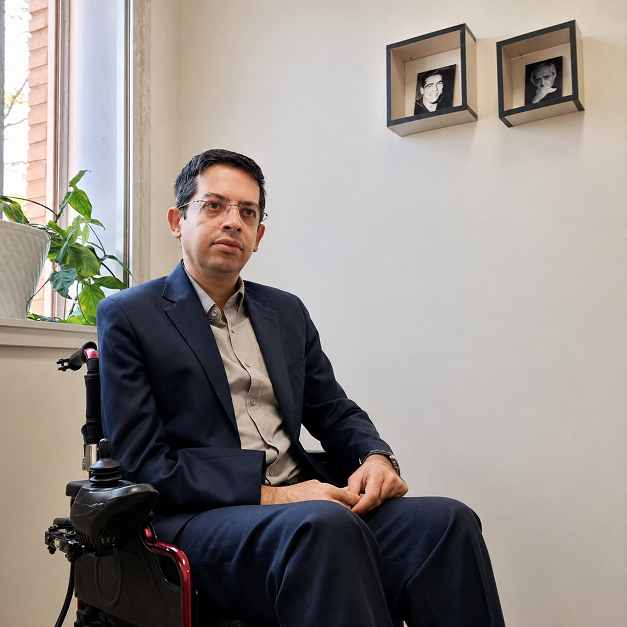
In an analytical interview, Dr. Nooh Monavvary, Assistant Professor in the Department of Sociology at the Faculty of Social Sciences, University of Tehran, elaborated on the concept of “labor-centered industrial policy”. He described it not merely as a strategy for supporting production, but as a social project aimed at reconstructing the relationship between the state, labor, skills, and development. Emphasizing a realistic understanding of Iran’s developmental conditions, he argued that human resources should not be viewed as a cost item but rather as the central pillar of development.
According to Monavvary, the significant gap between Iran and technology-driven leading economies requires an approach capable of engaging a substantial portion of the population in value-creation processes. A successful industrial policy establishes an inseparable link between economic growth, sustainable employment, skill enhancement, and broader public welfare. The lack of priority given to industrial development and its connection to work and social well-being in Iran has led to adverse consequences, including the expansion of unproductive activities, the emigration of skilled workers, job insecurity, and the erosion of the middle class.
Industry as a Social Concept
Explaining his educational and research approach, Monavvary regards industry and development as fundamentally social concepts that must be analyzed in relation to class structures, political institutions, employment quality, and the dignity of labor. He argues that many existing studies are either purely economic or institutional in focus, whereas a more comprehensive perspective should integrate political economy, the sociology of work, organizational studies, and development theory.
As he explains:
“Workers, employees, unemployed graduates, and even technical personnel should be understood beyond statistical definitions. They are social actors whose lived experiences, emotions, sense of status, hopes and frustrations, and class positions all play a role in the success or failure of a country’s development project.”
The Graduate Employment Crisis: A Disconnect Between Education and Production
Addressing the challenge of graduate unemployment, this University of Tehran faculty member argues that the core issue is not merely a shortage of jobs but rather the disconnect between higher education and the productive structure of the economy. Iran’s economy remains heavily dependent on raw-material exports, intermediary activities, and low-skill occupations, while unproductive activities often generate higher returns and consequently distort the country’s incentive structure.
He suggests that the government should restrict speculative and non-productive activities and, while identifying strategic leading industries, directly connect higher education and technical training systems to these sectors.
A Developmental State and the Need for a National Strategy
Acknowledging the difficulty of proposing a fully indigenous model, Monavvary highlights the importance of a developmental state—a state equipped with planning capacity, meritocratic governance, and long-term policymaking capabilities. He also emphasizes the critical role of inclusive institutions in reducing rent-seeking and monopolistic practices.
In his view, Iran’s primary challenge is not a lack of capital or technology but rather the inability to adhere consistently to the institutional rules required for development. If granted full authority, his first practical initiative would be the design and implementation of a National Labor-Centered Industrial Development Program -a transparent, time-bound strategy focused on selected priority industries.
Employment Quality: Beyond the Unemployment Rate
 Drawing on his field research, Monavvary stresses that Iran’s employment crisis extends beyond job availability and encompasses issues of income, social status, security, and future prospects. Previous employment-generation policies have failed to achieve sustainability because they were temporary in nature and disconnected from broader transformations in the industrial structure.
To assess the quality of employment, he proposes indicators such as job security, contract stability, access to social insurance, opportunities for career advancement, dignity in the workplace, work–life balance, and the absence of discrimination.
As he notes:
“Employment without an industrial policy typically results in fragile, informal, or temporarily subsidized jobs.”
He further argues that the unemployed should not be viewed as a social burden but rather as a dormant developmental capacity that can be transformed into a driving force for change through large-scale industrial and technological projects.
Social Implications and Policy Warnings
From the perspective of this sociologist, the implementation of a labor-centered industrial policy, if accompanied by meaningful social participation, could contribute to the revitalization of the middle class, the reduction of poverty, and the strengthening of public trust.
However, he warns that without institutional transparency and effective measures against rent-seeking, any development strategy risks producing new forms of monopoly and corruption. His central message to policymakers is that the country’s future requires a development-oriented consensus focused on poverty reduction, employment creation, and the equitable distribution of opportunities.
He concludes that industrial policymakers must break the vicious cycle of waste and corruption that has resulted from marginalizing development and reclaim their role as proactive agents capable of shaping a new horizon for an Iranian society still striving for development.
PARS MEDEQ company and the Mossalanejad Cultural Foundation are the sponsors of Vice-Presidency for Research and Technology News Desk
Your Comment :